In Richmond BC, geotechnical fieldwork often reveals a stark reality: the Fraser River delta deposits are among the most challenging in the Lower Mainland. The combination of soft organic silts, loose saturated sands, and interbedded clay layers demands more than a generic deep compaction plan. A vibrocompaction design here must account for a groundwater table sitting barely a meter below sea level and a seismic hazard profile that ranks among the highest in Canada. The design process starts by mapping the thickness of the liquefiable stratum, which in areas near No. 3 Road and Bridgeport frequently exceeds eight meters, and then defining the grid spacing and vibrator energy required to achieve a target relative density above 70 percent. For projects where the fines content surpasses 15 percent, our team often integrates verification with CPT testing to confirm that the treatment has eliminated the risk of pore pressure buildup during a design earthquake.
In Richmond, vibrocompaction design is fundamentally about preventing the liquefaction of deltaic sands during a magnitude 7.3 crustal earthquake.
Methodology applied in Richmond BC
Critical ground factors in Richmond BC
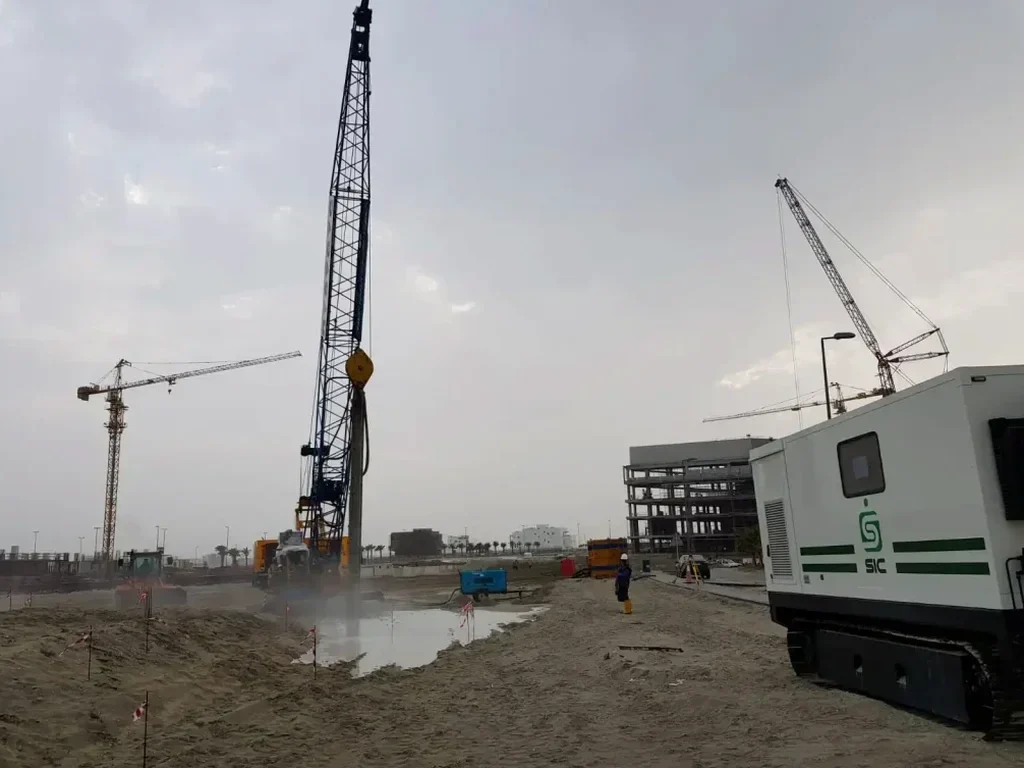
The vibroflot itself is a long, cylindrical steel probe with internal eccentric weights driven by an electric motor, and seeing it in action on a Richmond site is instructive. The machine induces horizontal vibrations that temporarily liquefy the surrounding sand, allowing grains to rearrange into a denser configuration. The primary risk in Richmond BC arises when the design underestimates the heterogeneity of the deltaic deposits. A lens of peat or soft organic clay, common in the Lulu Island area, can absorb the vibratory energy without densifying, creating a hidden soft spot under a future foundation. A flawed vibrocompaction design that ignores these pockets can lead to differential settlement of up to 100 millimeters, cracking floor slabs and damaging buried utilities. The design must also account for the effect of vibrations on adjacent structures; in the dense residential neighborhoods along Westminster Highway, pre-condition surveys and vibration monitoring plans are non-negotiable components of the design package.
Our services
A vibrocompaction design package for a Richmond BC site typically includes several coordinated investigation and analysis phases. The following works form the core of a deliverable that meets municipal permit requirements.
Seismic Site Response Analysis
Develop design response spectra for the specific Fraser Delta soil profile using equivalent linear or nonlinear modeling to quantify the liquefaction demand on loose layers.
Trial Compaction Program
Design and supervise a field trial with variable probe spacing to calibrate energy input, withdrawal rate, and grid geometry against post-treatment CPT results.
Post-Treatment Verification
Specify the number and location of confirmatory CPT tests and grain size analyses required to validate that performance criteria have been met across the treatment zone.
Vibration Monitoring Plan
Establish peak particle velocity limits and monitoring protocols to protect nearby infrastructure during compaction, in compliance with City of Richmond noise and vibration bylaws.
FAQ
What does a typical vibrocompaction design package cost in Richmond BC?
For a standard commercial or light industrial lot in Richmond, a vibrocompaction design package generally falls between CA$2,060 and CA$6,990, depending on the complexity of the stratigraphy and the extent of the trial compaction program required.
How does the high water table in Richmond affect the vibrocompaction process?
The near-surface groundwater in Richmond actually facilitates vibrocompaction by keeping the sands in a saturated state, which reduces intergranular friction and allows the vibratory energy to propagate more effectively. However, it also means the design must include careful specifications for the withdrawal rate to prevent the borehole from collapsing before the stone backfill is placed.
Can vibrocompaction treat the organic silts found across Lulu Island?
No, vibrocompaction is ineffective in cohesive, organic soils. Our designs for Richmond sites address this by identifying the clean sand layers that can be treated and specifying alternative ground improvement, such as rigid inclusions or preloading with wick drains, for the intervening compressible silts.
What is the minimum distance from existing buildings required for vibrocompaction?
In Richmond's residential areas, we typically maintain a minimum buffer of 8 to 10 meters from occupied structures, with a detailed vibration monitoring plan in place. The exact distance is determined during the design phase based on the building's condition, foundation type, and the energy output of the selected vibroflot.