A common mistake we see in Richmond is treating a 20-meter-deep silt deposit like a stiff glacial till. It isn't. The Fraser River Delta stratigraphy is notoriously variable—interbedded sands, soft silts, and organic layers that can compress unevenly under load. An SPT done right provides the blow count record that separates a stable pile length from a costly settlement problem. The test itself follows ASTM D1586: a 140-pound hammer drops 30 inches, a split-spoon sampler advances, and the number of blows per 6 inches tells the story. In Richmond, where groundwater sits high and the seismic hazard is real, the raw N-value alone isn't enough—we correct for overburden pressure and energy ratio to give you numbers you can actually use in a liquefaction analysis or a deep foundation design that meets NBCC requirements.
Richmond sits on 300 meters of deltaic sediment. Blow count data without energy correction is just a number—corrected N60 values are engineering facts.
Methodology applied in Richmond BC
Procedure video
Critical ground factors in Richmond BC
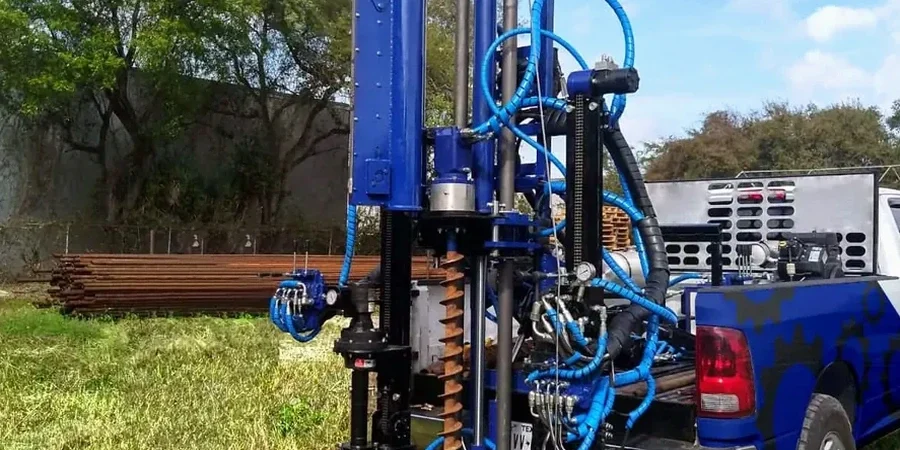
The drill rig that arrives on site is a truck-mounted CME-75 or equivalent, running hollow-stem augers through the silts and sands typical of Richmond. Without proper mud control, the borehole collapses above the water table—and around here, the water table sits barely two meters down. Collapse means lost data, wasted meterage, and a frustrated crew. Worse, if you skip the SPT and rely solely on CPT or geophysical methods, you miss the physical sample. In deltaic soils with thin organic seams, that sample is the only way to confirm peat or compressible lenses that will consolidate under fill. The Fraser River Delta also carries a moderate-to-high liquefaction susceptibility; uncorrected SPT data produces overly conservative or dangerously optimistic seismic microzonation results. Our field protocols require continuous sampling through the critical upper 30 meters—exactly what the NBCC seismic provisions expect.
Our services
SPT drilling is just one piece of the subsurface investigation puzzle. In Richmond's deltaic environment, we often combine it with these works:
Instrumented SPT with Energy Monitoring
Every blow counts, literally. We attach rod-mounted accelerometers to record the actual energy delivered to the sampler. This eliminates the uncertainty of hammer efficiency and gives you true N60 values for liquefaction triggering analysis.
Liquefaction Assessment Package
Combining SPT data with Seed & Idriss simplified procedures, we calculate factor of safety against liquefaction at multiple depths. Required for most mid-rise and high-rise structures in Richmond's seismic design category.
Deep Foundation Recommendations
Using corrected SPT N-values, we deliver pile capacity estimates—skin friction and end bearing—for driven piles, drilled shafts, or helical piles. Every recommendation accounts for the compressible layers unique to the Fraser Delta.
Laboratory Testing Suite
Disturbed samples from the split-spoon go straight to our lab for moisture content, grain size distribution, and Atterberg limits. These index properties calibrate the SPT-based correlations and confirm soil classification.
FAQ
How deep do you typically drill SPT boreholes in Richmond?
Most projects in Richmond require boreholes between 20 and 45 meters deep. The exact depth depends on the structure load and foundation type. The Fraser Delta sediment package extends over 300 meters in places, but the critical zone for seismic site classification and pile design is the upper 30 meters. We sample continuously through that interval and extend deeper if the structural loads warrant it or if a deeper bearing stratum is needed.
What does SPT testing cost in Richmond?
For a standard SPT borehole in Richmond—mobilizing a truck-mounted rig, drilling through deltaic soils with hollow-stem augers, and sampling at 1.5-meter intervals—the cost typically runs between CA$630 and CA$1,080 per borehole. The range depends on total meterage, site access, and whether we're also conducting energy measurements or collecting undisturbed samples. A multi-borehole program usually brings the per-hole cost toward the lower end.
How is the SPT N-value corrected for Richmond's soil conditions?
We apply three corrections to the raw blow count. First, an energy correction to normalize to 60% theoretical free-fall energy—our automatic hammers are instrumented, so we use measured energy ratio, not an assumed one. Second, an overburden correction per Liao & Whitman to account for the vertical effective stress at depth, which is significant in Richmond's normally consolidated silts. Third, a rod length correction when drilling deeper than 10 meters. The result is the N1(60) value used in liquefaction analysis and foundation design.
Can you drill SPT boreholes in Richmond's winter conditions?
Yes, we operate year-round. Richmond's winter brings rain and high groundwater, not frozen ground. The main challenge is site access—saturated silt turns to mud quickly under truck traffic. We use timber mats or gravel pads to keep the rig stable and prevent rutting. The drilling itself isn't affected; hollow-stem augers handle wet conditions well, and we grout the borehole upon completion to prevent vertical migration of water between aquifers.