A recurring structural design error on Lulu Island is applying conventional fixed-base assumptions to buildings situated on Richmond’s deep, compressible deltaic deposits. When a mid-rise structure ignores the amplification effects of 30 to 50 meters of silty clay over glacial till, the seismic demand transmitted to the superstructure is grossly underestimated. Base isolation seismic design directly addresses this by decoupling the structure from ground motion, a strategy that becomes essential where the peak ground acceleration can be magnified by a factor of two or more through the soft soil column. Our approach integrates site-specific hazard spectra from NBCC 2020 with advanced nonlinear time-history analysis, ensuring the isolation system—typically lead-rubber or high-damping rubber bearings—is tuned to the long-period energy characteristic of a magnitude 9 Cascadia subduction event. Before finalizing the isolation parameters, we often review subsurface data from a companion CPT test to refine the soil profile used in the geotechnical model, and correlate results with liquefaction potential assessments that are critical for any deep foundation element supporting the isolation plane.
On Richmond’s Site Class E soils, base isolation shifts the structural period beyond the amplified spectral peak, cutting base shear demand by up to 50 percent in a Cascadia scenario.
Methodology applied in Richmond BC
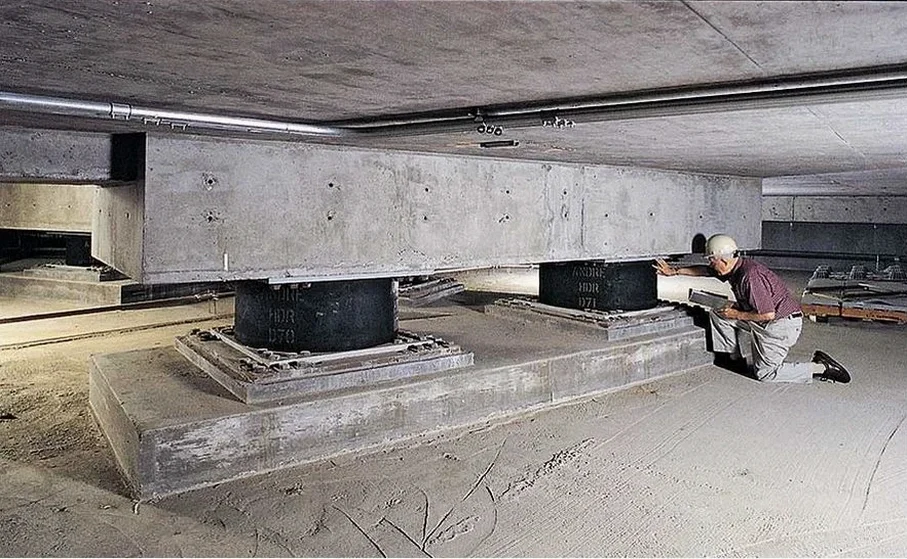
Critical ground factors in Richmond BC
A six-storey residential project planned near No. 3 Road encountered a critical design flaw during peer review: the original scheme used a rigid moment frame with a fundamental period of 0.8 seconds, placing it directly within the amplified spectral peak for the site’s Site Class E soils. Modal analysis revealed that the base shear demand would exceed the structural capacity by nearly 40 percent under the 2,475-year return period event. The remediation involved a complete redesign incorporating a base isolation seismic design system with a target period of 2.8 seconds, shifting the response well beyond the dominant ground motion frequencies. This single intervention reduced inter-storey drifts by over 60 percent and eliminated the need for costly viscous dampers throughout the vertical framing. The lesson is unmistakable: on Richmond’s saturated Fraser River sediments, attempting to resist seismic forces through strength alone is an exercise in diminishing returns, whereas an isolation strategy directly manages the energy input at the foundation interface.
Our services
The successful execution of a base isolation seismic design project in Richmond demands a tightly integrated workflow spanning geotechnical investigation, structural dynamics, and specialty testing. Our technical team coordinates each phase, from initial soil characterization through to peer review submission, ensuring the isolation strategy is both analytically solid and practically buildable within the constraints of the site.
Site-Specific Seismic Hazard Analysis
Development of uniform hazard spectra and acceleration time histories for Richmond coordinates, incorporating basin edge effects from the Georgia Strait and long-period amplification through the deltaic soil column.
Isolation System Configuration & Sizing
Nonlinear modeling of lead-rubber, high-damping rubber, or friction pendulum systems to determine optimal bearing diameter, lead core size, and spatial layout that minimizes torsional response while respecting architectural constraints.
Nonlinear Time-History Analysis
Full 3D finite element modeling with fiber-hinge frame elements and isolator link elements, subjected to spectrally matched ground motion suites, to verify inter-storey drift limits and isolation plane displacement demands per NBCC 2020.
Prototype Testing Specification & Oversight
Preparation of test protocols aligned with ASCE/SEI 7-22 criteria for full-scale bearing qualification, including compression-shear cycles, aging effects, and scragging recovery, with on-site witness during the factory testing program.
FAQ
What makes base isolation design in Richmond different from standard seismic design?
Richmond sits on deep, soft Fraser River delta deposits classified predominantly as Site Class D or E under NBCC 2020. These soils amplify long-period ground motion, so a conventional fixed-base structure designed for the same spectral acceleration will track record significantly higher drift and base shear. Base isolation specifically lengthens the structural period to bypass the amplified range, a strategy that is far more effective here than on firm ground sites in Vancouver.
Which types of buildings in Richmond benefit most from base isolation?
Structures of three to twelve storeys with regular mass distribution gain the greatest advantage, as their fixed-base fundamental period often falls within the 0.5 to 1.5 second range where soft soil amplification is most severe. Essential facilities—hospitals, emergency operations centers, and data centers—are particularly strong candidates because the isolation system protects both the structure and the sensitive internal equipment during a major seismic event.
How does the proximity to the Fraser River and sea level affect the isolation system design?
The high water table in Richmond, typically within 1 to 2 meters of the surface, requires that the isolation plane be located above a solid, waterproofed foundation structure. For buildings with basements, the moat wall must be designed to resist hydrostatic pressure while accommodating lateral displacement. The design also considers the potential for soil liquefaction at depth, which can reduce the lateral support to pile caps—this is where integration with a deep excavation monitoring plan becomes valuable during construction.
What is the rough cost range for base isolation seismic design services for a building in Richmond?
For a typical mid-rise structure in Richmond, the engineering design fees for the base isolation system—including seismic hazard analysis, isolator configuration, nonlinear modeling, and testing specifications—generally fall between CA$6,150 and CA$10,010 for the consulting scope. The final figure depends on building complexity, number of required ground motion sets, and the extent of peer review coordination.
Can base isolation be retrofitted to an existing building in Richmond?
Retrofit application is technically feasible but involves significant coordination. The existing columns must be temporarily supported while the isolation bearings are inserted at the foundation level, a process that requires careful jacking sequences and column transfer details. The technical viability depends on the existing foundation type and the building’s lateral system regularity; a detailed structural assessment is always the first step.