The geotechnical contrast between a site on the elevated eastern edge of Richmond near Highway 99 and one closer to the western dike along the Strait of Georgia can be the difference between a straightforward excavation and a water-charged stability failure. The former might encounter slightly denser over-consolidated silts at depth, while the latter sits over 100 meters of unconsolidated Fraser River deltaic deposits where the water table is essentially at grade. Designing a deep excavation here without accounting for that spatial variability is a gamble no contractor should take. Our laboratory team supports these designs with high-quality index testing from undisturbed samples, allowing the engineering analysis to reflect the real stratigraphy at the specific block, not a regional generalization. When the shoring system must extend below the artesian aquifer that underlies much of the Lulu Island ground, we combine routine classification with a triaxial testing program to define the undrained shear strength profile that governs the temporary works stability.
The key to deep excavation safety in the Fraser Delta lies in quantifying the undrained strength anisotropy of the local clay, not just its average Su.
Methodology applied in Richmond BC
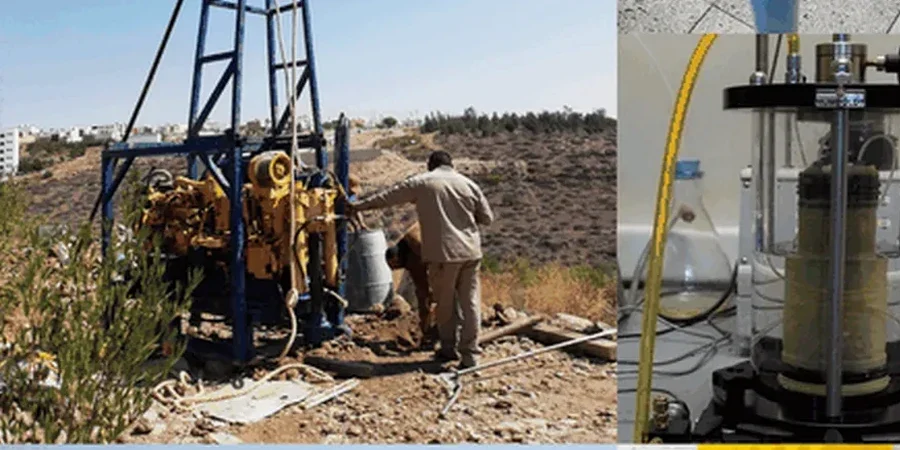
Critical ground factors in Richmond BC
Richmond's transformation from a patchwork of intertidal bogs and farmlands into a dense urban center through the mid-20th century created a legacy of buried organic horizons and undocumented fill pockets that now complicate every major excavation. Historical drainage ditches and sloughs were routinely infilled with dredge spoils and construction debris, leaving compressible, heterogeneous zones that can concentrate lateral strains and trigger localized instability in an otherwise solid shoring design. The city's location within the Cascadia subduction zone amplifies these risks, as a moderate earthquake can generate excess pore pressures in the loose saturated sands, potentially leading to a flow slide into the open cut if the dewatering system loses power. A liquefaction assessment is not an optional add-on here; it is the critical design scenario for the base slab drainage blanket and the permanent retaining structures that must resist post-seismic lateral spreading pressures.
Our services
Our technical support for deep excavation projects in Richmond covers the full analytical workflow from sampling to shoring optimization.
Shoring System Design
We deliver detailed design of soldier pile and lagging, secant pile, or diaphragm walls calibrated with site-specific soil parameters derived from our laboratory testing program, ensuring compliance with WorksafeBC Part 20 excavation safety requirements.
Construction-Phase Monitoring and Analysis
We implement inclinometer, piezometer, and optical survey arrays around the excavation perimeter, comparing real-time deflection data with the design predictions to validate the soil constitutive model and trigger contingency measures if movements exceed 75% of the allowable limits.
FAQ
How much does a deep excavation geotechnical design cost for a site in Richmond?
For a standard commercial excavation in Richmond, the complete geotechnical design package, including site investigation oversight, laboratory strength and consolidation testing, finite element analysis, and sealed construction drawings, typically ranges from CA$2,470 to CA$11,390. The final cost depends on the excavation depth, the complexity of the adjacent infrastructure, and the number of shoring alternatives analyzed to optimize the construction cost.
What level of ground movement is considered acceptable during excavation?
We typically design for a maximum lateral wall deflection of 0.5% of the excavation depth adjacent to sensitive structures, tightening to 0.2% where heritage buildings or high-pressure gas mains exist within the zone of influence. These limits are verified during construction through our excavation monitoring system that tracks both horizontal and vertical displacements in real time.
How do you handle the high groundwater table during a deep dig in Richmond?
Our designs integrate a two-stage dewatering approach: a perimeter wellpoint system to lower the phreatic surface below the cut, and a deep cutoff wall keyed into the underlying low-permeability till to minimize recharge from the Fraser River. We verify the hydraulic conductivity assumptions through field in-situ permeability testing before finalizing the pump capacity and spacing.
What seismic provisions apply to permanent retaining walls in Richmond?
We design permanent walls for the 2,475-year return period seismic event per NBCC 2020, incorporating a post-liquefaction lateral spreading pressure where the simplified CPT-based triggering analysis indicates significant strain potential in the foundation sand layers. The wall section and reinforcement are detailed to accommodate the ductility demands without compromising the drainage system.