Richmond sits at the mouth of the Fraser River, barely a meter above sea level in many areas, and the saturated deltaic deposits here create a retaining wall design scenario unlike anywhere else in Metro Vancouver. The combination of deep organic silts, loose sands, and a groundwater table that often sits just centimeters below grade means every retaining wall design must account for buoyancy, long-term settlement, and aggressive corrosion potential. Our technical team approaches each project with a thorough understanding of how these interbedded layers behave under load, integrating CPT testing to map the stratigraphy continuously and slope stability analysis when walls intersect existing grades. With Richmond’s population exceeding 230,000 and development pressure pushing into marginal lands, getting the geotechnical parameters right before excavation is the only way to avoid costly surprises.
In Richmond’s deltaic environment, a retaining wall is only as good as the drainage system behind it—hydrostatic pressure is the primary failure mechanism we mitigate in every design.
Methodology applied in Richmond BC
Critical ground factors in Richmond BC
Richmond’s last significant earthquake vulnerability assessment, updated in the Metro Vancouver seismic microzonation studies, confirms that the Fraser delta amplifies ground motion considerably—a 0.94g short-period spectral acceleration is not a conservative number on paper, it is the design reality. A retaining wall design that ignores liquefaction-induced lateral spreading risks catastrophic failure, particularly along the dyke networks and the eastern edge of the city near the river. The post-liquefaction loss of passive resistance in front of the wall toe can trigger a rotational failure within seconds of strong shaking. We incorporate residual strength parameters from liquefaction analysis into our models and often specify ground improvement beneath the wall footprint when SPT blow counts drop below critical thresholds. Drainage redundancy is non-negotiable: we detail multiple weep hole rows and continuous gravel drains because a clogged system means hydrostatic buildup that pushes the wall past its design moment capacity.
Our services
We support Richmond projects from preliminary feasibility through construction administration, adapting the retaining wall design to the specific constraints of each site and budget.
Cantilever & Gravity Wall Engineering
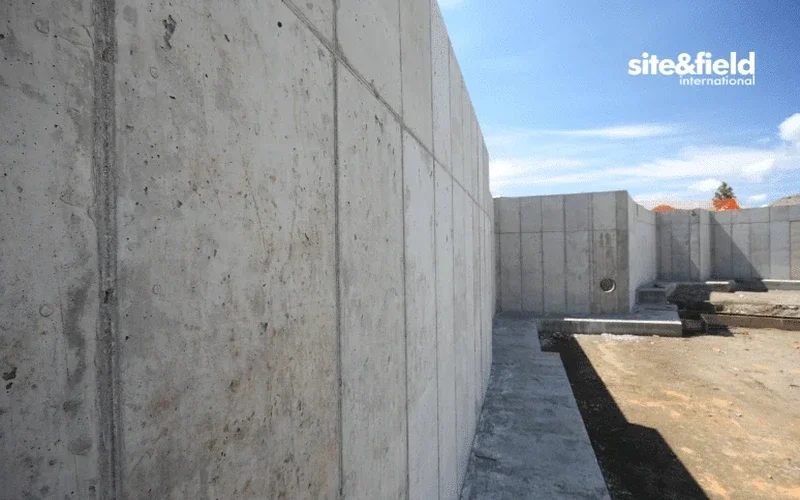
Reinforced concrete cantilever walls and mass gravity walls designed for Richmond’s soft foundations, including bearing capacity checks and global slope stability verification.
MSE Wall & Segmental Block Design
Mechanically stabilized earth systems using geogrid reinforcement, ideal for taller walls on compressible soils where differential settlement must be controlled.
Temporary Shoring & Excavation Support
Soldier pile and lagging walls, sheet pile walls, and soil nail systems for deep excavations adjacent to existing structures in Richmond’s urban areas.
Drainage & Waterproofing Specification
Detailed drainage plans including perforated pipe networks, filter fabric, gravel drains, and waterproofing membranes to eliminate hydrostatic pressure buildup.
FAQ
What retaining wall types work best in Richmond’s high water table conditions?
Cantilever reinforced concrete walls and mechanically stabilized earth (MSE) walls generally perform well here, provided they have solid drainage systems. The key is designing for full hydrostatic pressure and using free-draining backfill. We typically avoid unreinforced gravity walls above 1.2 meters in Richmond because the soft foundation soils can cause tilting over time.
How do you account for seismic loads in retaining wall design?
We apply the NBCC 2020 seismic provisions using the Mononobe-Okabe method to calculate the dynamic earth pressure increment. For Richmond’s hazard level, we also evaluate the potential for liquefaction behind and in front of the wall, which can drastically increase lateral loads or reduce passive resistance. Post-liquefaction residual strengths are used when the factor of safety against liquefaction drops below 1.1.
What is the typical cost range for a retaining wall design in Richmond BC?
Engineering fees for a retaining wall design in Richmond generally range from CA$1,570 to CA$5,560, depending on wall height, complexity, and whether additional investigation like CPT or triaxial testing is required. This covers the geotechnical analysis, structural calculations, and stamped drawings suitable for building permit submission.
Do I need a retaining wall permit in Richmond?
Yes. The City of Richmond requires a building permit for retaining walls over 1.2 meters in height, or any wall supporting a surcharge such as a driveway or building. Our stamped engineering drawings meet the municipal submission requirements and address the specific geotechnical conditions noted in the city’s development guidelines.
How do you address corrosion of reinforcement in Richmond’s soils?
Richmond’s deltaic soils can be aggressive to steel due to high moisture, organic content, and occasional salinity influence from the Fraser River estuary. We specify increased concrete cover, galvanized or epoxy-coated rebar, and sometimes use fiber-reinforced polymer alternatives. A geotechnical investigation helps determine the site-specific corrosion potential.