Richmond sits on deep delta deposits that challenge every foundation. The ground here is mostly silts and clays with high compressibility. We see settlement problems in almost every project that skips ground improvement. Stone column design becomes essential when bearing capacity is low and consolidation time is unacceptable. Our lab runs grain-size and Atterberg limits tests first. Those index properties define the column length and diameter. We then use vibro-replacement methods tailored to the soft Lulu Island formation. The design accounts for lateral confinement from the native silt, which is often poor and requires closer spacing. In this region, CPT soundings deliver the continuous profile needed to estimate undrained shear strength, while liquefaction assessment verifies column performance during a seismic event.
A stone column in Richmond silt is not a pile. It improves the ground mass, not bypasses it.
Methodology applied in Richmond BC
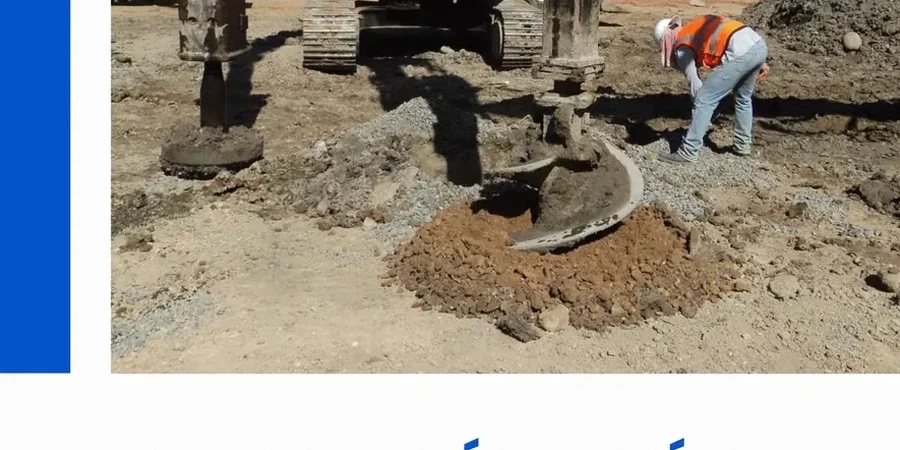
Critical ground factors in Richmond BC
A warehouse project on River Road had a design that ignored the peat lens at 4 metres depth. The stone columns terminated above it. Six months after handover, the slab settled 90 millimetres. The fix cost more than the original ground improvement. This happens when the design relies on regional assumptions instead of site-specific borehole data. Richmond's stratigraphy changes within a single lot. A missing silt seam or an undetected artesian condition can reduce column confinement drastically. We always pair the design with a full-depth CPT or SPT log. The column must penetrate the weak layer fully and bear on competent material. Seismic demand under NBCC also requires a post-liquefaction settlement check. A design that looks fine under static load can fail under the design earthquake if the residual strength of the host soil is overestimated.
Our services
Our stone column design work in Richmond covers the full sequence from investigation to validation. We start with the geotechnical model and end with a load test report.
Design Package
Complete stone column layout with settlement and stability calculations. Includes grid geometry, depth profile, material spec, and installation sequence. Signed and stamped by a registered professional.
Pre-Design Site Investigation
CPT, SPT, and laboratory index testing on Shelby tube samples. We define the undrained shear strength profile, compressibility parameters, and groundwater conditions for the design.
Post-Installation Validation
Plate load tests and zone CPT checks to confirm the achieved modulus and column integrity. We compare results against the design assumptions and issue a compliance report.
FAQ
What is the typical design life of a stone column system in Richmond?
The design life matches the structure's requirement, usually 50 to 75 years. The stone is inert and does not degrade. The key is the column's long-term confinement. We check that the surrounding silt does not migrate into the column over time under fluctuating groundwater. A properly designed filter layer prevents this.
How much does a stone column design cost for a Richmond project?
The design fee ranges from CA$1,880 to CA$6,620 depending on the site area, number of columns, and complexity of the soil profile. A small commercial lot with a uniform profile is at the lower end. A large industrial site with peat pockets and a seismic analysis requirement is at the upper end.
How do you verify the stone column design after installation?
We run a combination of plate load tests on isolated columns and CPT soundings in the treated zone. The load test gives a direct modulus value. The CPT confirms that the column material is continuous and dense. We compare both results against the design settlement criteria before the structural slab is poured.
What makes Richmond soil particularly challenging for stone columns?
The high groundwater table and the presence of compressible organic silts and peat lenses. The undrained shear strength is often below 15 kPa in the upper 5 metres. This low confinement can cause excessive bulging. The design must account for a reduced column capacity in these zones, often requiring a larger diameter or a closer grid spacing.