A tracked drill rig maneuvering between the warehouse foundations on No. 5 Road tells you most of what you need to know about building in Richmond. The heavy equipment sinks noticeably as it positions, even on compacted gravel pads. That’s the reality of the Fraser River delta—up to 300 meters of saturated, compressible silts and clays sitting on glacial till. For any multi-storey or industrial structure here, a conventional isolated footing pad is often a gamble. The reliable approach is a raft, or mat foundation, that spreads the structural load across the entire footprint. When we mobilize for a CPT test on Lulu Island, we are not just checking bearing capacity. We are mapping the exact depth where the soil transitions from soft to stiff, because that data determines whether a rigid slab or a compensated mat makes economic sense for your project.
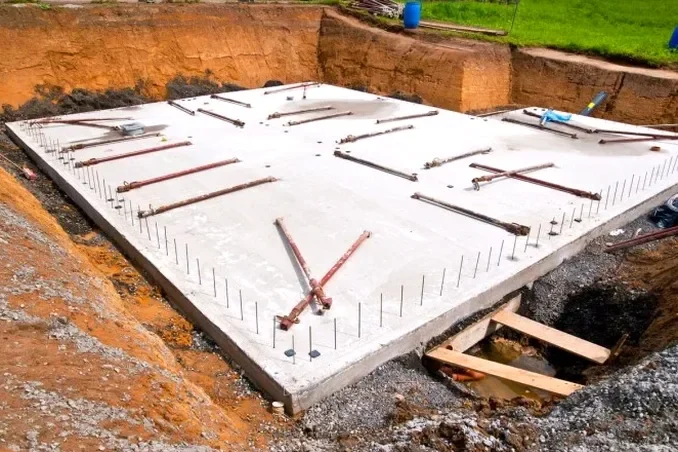
A raft foundation on Richmond’s delta soils acts as a rigid plate, forcing the ground to settle evenly under the entire building load.
Methodology applied in Richmond BC
Critical ground factors in Richmond BC
The damp, marine air that hangs over Richmond accelerates more than just rust on rebar cages. It masks a deeper risk: long-term creep settlement in the organic silts that lie buried across much of the island. A mat foundation design that ignores secondary consolidation can leave a building slowly sinking for decades after construction. We have seen industrial floors on No. 6 Road develop a 40 mm dip in just three years because the preloading phase was cut short. That’s why our specifications for Richmond projects always include a strict protocol for surcharging and settlement monitoring before the structural slab is poured. Cutting this step to save schedule is a direct path to a failed floor slab.
Our services
Our mat foundation design package covers every phase from initial soil investigation to reinforcement detailing. We deliver a stamped, construction-ready drawing set tailored to your Richmond site.
Geotechnical Investigation & Parameter Derivation
We execute the field program—CPT soundings, test pits, and sampling—to derive the modulus of subgrade reaction and consolidation parameters specific to your Richmond location. No assumed textbook values.
Structural Raft Design & FEA Modeling
We model the soil-structure interaction using finite element software, accounting for varying soil stiffness zones under the mat. Outputs include bending moment envelopes, shear diagrams, and optimized reinforcement schedules per CSA A23.3.
Settlement Monitoring & Construction Review
During the surcharging phase, we install settlement plates and piezometers to track consolidation progress. We only release the foundation for concrete placement when the monitored settlement rate meets the design threshold.
FAQ
What is the typical cost range for a raft/mat foundation design in Richmond?
For a standard single-family or small commercial project in Richmond, the engineering design for a raft or mat foundation typically falls between CA$1,470 and CA$5,500. The final fee depends on the building footprint, the number of storeys, and the complexity of the soil profile. A design for a large industrial building on a site with deep soft clays will be at the upper end, as it requires more detailed finite element modeling and settlement analysis.
How does a raft foundation handle Richmond’s high water table?
The design incorporates the buoyancy and hydrostatic pressure directly into the structural calculations. We specify a waterproofing system and a well-graded sub-slab drainage layer that connects to a sump. The mat’s dead load must exceed the uplift force from the water table, which is often near the surface in Richmond. If it doesn’t, we either thicken the slab or specify a drained basement system to relieve the pressure.
Do I need a raft foundation for a house on a standard 33-foot lot in Richmond?
Not always, but it’s a common solution. Many older Richmond homes on narrow lots used strip footings and have since experienced significant differential settlement. A raft foundation, even a thin one with edge thickening, provides much better performance on the compressible delta soils. We assess the specific soil conditions at your site, but a mat is often the most cost-effective insurance against future cracking and doorframe racking.