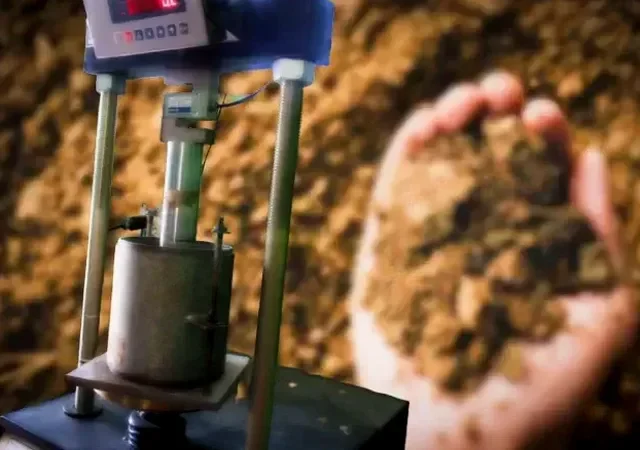
Richmond sits on a deep alluvial basin where the Fraser River meets the Pacific, and the near-surface geology across Lulu Island is dominated by compressible silts, organic clays, and peat lenses that can exceed 20 meters in thickness. Anyone who has driven the Westminster Highway after a wet winter knows the subgrade doesn't just get soft — it loses bearing capacity in ways that standard field observations can miss. A laboratory CBR test run on an undisturbed Shelby-tube sample or a carefully recompacted bulk specimen gives you a direct number for that behavior, referenced against the moisture-density relationship the contractor will chase during compaction. We process the material at our Surrey lab under controlled saturation, so the soaked CBR value reflects the worst-case scenario Richmond actually delivers eight months of the year. For granular fills imported from the Sumas Mountain quarries, we also run the unsoaked comparison to bracket the full performance range before a single lift of asphalt goes down.
A soaked CBR value measured in the lab predicts subgrade behavior under Richmond's high water table far better than any dry-condition number ever will.
Methodology applied in Richmond BC
Critical ground factors in Richmond BC
Richmond's transformation from floodplain farmland to one of Metro Vancouver's densest suburbs happened fast, and a lot of the early infrastructure was built on shallow mat foundations or thin pavement sections that assumed better ground than actually existed. The city's drainage network still relies on a system of pumps and dikes because the natural groundwater sits less than a meter below grade across much of the island. That hydraulic reality means a road subgrade that tests at 6 percent CBR in August can drop below 2 percent by January if the pavement structure wasn't designed for the soaked condition. The consequence isn't just cracking — it's differential settlement that breaks the curb-and-gutter line and channels stormwater into the base course, accelerating the failure cycle. When we scope a CBR program for Richmond, we insist on sampling at the anticipated formation level after any organic stripping, and we run enough companion moisture content determinations to tie the strength directly to the compaction curve the contractor will follow.
Our services
Our Richmond-focused pavement geotechnics work integrates the laboratory CBR with the field data you need for a defensible structural design, especially on the variable delta soils.
CBR for Flexible Pavement Design
We prepare specimens at target moisture and density from bulk samples taken at the subgrade elevation, run the 96-hour soaked test per ASTM D1883, and deliver CBR values at 2.5 mm and 5.0 mm penetration for direct input into the AASHTO 1993 or MEPDG structural design methods.
Correlative Subgrade Investigation
Combining the lab CBR with in-situ density testing and DCP profiles lets us calibrate the strength-depth relationship across the entire site, reducing the risk of missing a weak lens of organic silt between two stiffer layers.
FAQ
How much does a laboratory CBR test cost for a Richmond project?
A single-point soaked CBR test, including compaction to a specified Proctor level and the full 96-hour soak, typically runs between CA$190 and CA$310 per specimen. The exact cost depends on whether we are preparing the specimen from a bulk sample or trimming an undisturbed tube, and how many moisture-density points are required for the companion Proctor curve.
Why is the soaked CBR value so important in Richmond specifically?
Because the water table across Lulu Island and Sea Island sits very high, often within a meter of the surface during the wet season. The soaked CBR test submerges the specimen for 96 hours to simulate the saturated condition the subgrade will actually track record, giving a far more realistic strength input than a dry or unsoaked value.
Do you need an undisturbed sample or a bulk sample for the lab CBR?
For cohesive silts and clays typical of Richmond, we can run the CBR on undisturbed Shelby-tube samples taken from the subgrade level. For granular or recompacted fills, a bulk sample is sufficient — we reconstitute the specimen in the lab at the target moisture and density specified in the project's compaction specification.
What CBR value is generally required for residential streets in Richmond?
The City of Richmond engineering standards typically look for a design CBR of at least 3 to 5 percent at the subgrade level for local residential streets, though that target can shift based on traffic loading and the pavement structure type. For collector roads or industrial access routes, the required subgrade CBR often climbs above 8 percent, and if the natural soil can't hit that number, we discuss stabilization or a thicker granular base.
How long does it take to get CBR results from the lab?
The standard soaked CBR requires a 96-hour (four-day) submersion period, plus the time for compaction, setup, and penetration testing. Typically, you'll have the full report in five to seven business days from the date the sample arrives at the lab. More info.