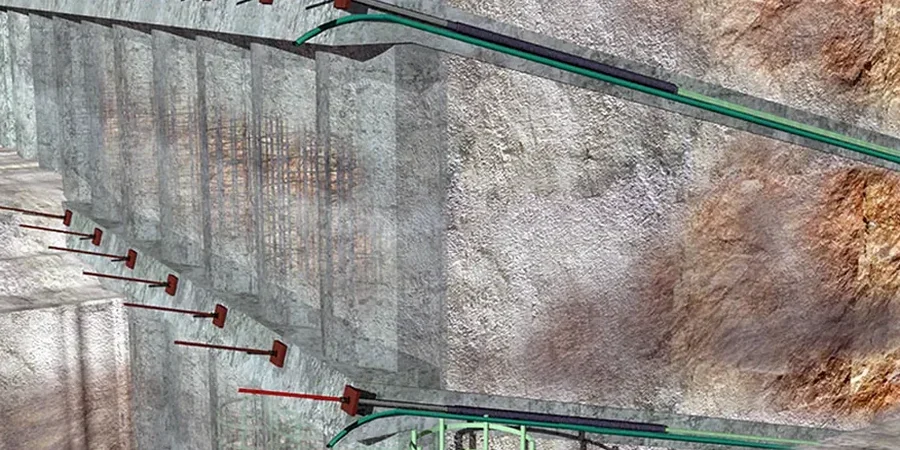
The National Building Code of Canada requires that any permanent or temporary earth retention system in Richmond be designed for the specific challenges of the Fraser River delta. This isn't just a formality. The city sits on deep deposits of compressible silts and clays — up to 200 meters in some areas — overlaid by loose sands that can liquefy under seismic loading. We apply active and passive anchor design to transfer tensile loads into competent bearing strata well below the soft near-surface layers. A pre-stressed active anchor immediately engages the ground, limiting wall deflections during excavation, which is critical next to the city's aging infrastructure. Passive anchors, which develop resistance through ground movement, suit less sensitive cut slopes along Highway 99 or the rail corridors. Every design we deliver integrates site-specific CPT test data to map the deltaic stratigraphy and confirm bond zone capacity before a single tendon is ordered.
In Richmond's deltaic soils, the difference between a working anchor and a failed one is knowing exactly where the bond zone sits relative to the compressible layers.
Methodology applied in Richmond BC
Critical ground factors in Richmond BC
The most persistent mistake we see in Richmond is anchoring into the upper 10 meters of the soil profile without verifying that the bond zone is below the highly compressible organic silts. A contractor might hit reasonable blow counts during installation and assume the ground is competent. It isn't. The near-surface clays at depths of 3 to 8 meters are normally consolidated and prone to long-term creep under sustained tension. An anchor locked off in that zone will relax over weeks, losing pre-stress and allowing the wall to deflect — sometimes enough to crack adjacent slabs or damage buried utilities. We routinely extend the bond length into the dense Pleistocene sands or till that underlies the deltaic deposit, typically encountered below 15 to 20 meters in the city center. Without a proper geotechnical investigation, the risk isn't just serviceability failure; it's a progressive collapse scenario if multiple anchors in a row lose capacity during a seismic event.
Our services
Our anchor design work in Richmond covers both temporary excavation support and permanent retaining structures. We handle the full design package from geotechnical investigation through proof testing.
Active Tieback Anchor Design
Pre-stressed anchors for shoring walls along deep excavations in Richmond's city center. We design the free length to bypass potential failure wedges and the bond length to develop capacity in the Pleistocene bearing unit. Loads typically range from 300 to 1,200 kN depending on wall height and soil profile.
Passive Anchor and Soil Nail Design
Fully grouted passive anchors and soil nails for slope stabilization along dike access roads and cut faces near the Fraser River. These systems mobilize resistance gradually as the soil mass deforms, providing long-term reinforcement without the need for stressing access.
FAQ
What is the difference between active and passive anchors for a project in Richmond?
Active anchors are pre-stressed immediately after grouting to actively apply a compressive force to the retained soil, which minimizes wall movement before excavation proceeds — important in Richmond's soft silts where even small deflections can damage adjacent infrastructure. Passive anchors are not pre-stressed; they develop their resisting force only when the ground begins to move, making them suitable for cut slopes or less deformation-sensitive applications.
How deep do anchors need to go in Richmond's soil conditions?
Bond zones typically need to extend into the dense Pleistocene sands or till, which in Richmond are generally encountered between 15 and 25 meters below ground surface, depending on the specific location relative to the Fraser River paleochannels. Anchors bonded in the upper Holocene clays are at high risk of creep and should be avoided unless detailed long-term settlement analysis demonstrates acceptable performance.
What does active/passive anchor design cost in Richmond BC?
The engineering design package for an anchored retaining wall system in Richmond typically falls between CA$1,570 and CA$5,700 depending on the number of anchor rows, wall height, and the complexity of the subsurface profile. This covers geotechnical interpretation, bond length calculations, tendon selection, corrosion protection design, and preparation of testing procedures.